





- News
- Record low vacancy pushes Singapore office rents up in Q1, tilts market in landlords’ favour
Record low vacancy pushes Singapore office rents up in Q1, tilts market in landlords’ favour
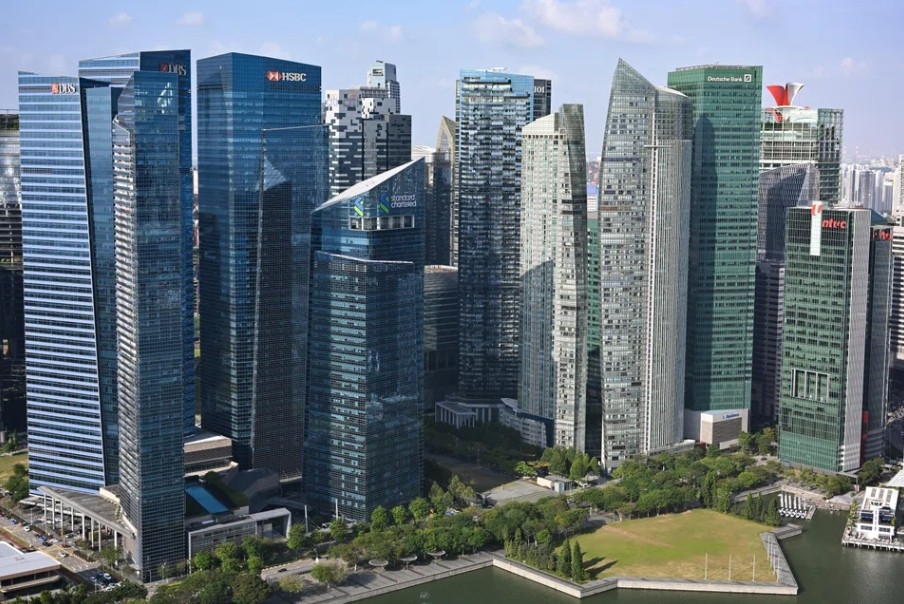
Singapore’s office market tightened further in the first quarter of 2026, with vacancy rates falling to multi-year lows and rents extending their growth streak, supporting landlord pricing power.
While current market dynamics point to near-term resilience, Singapore’s continually rising business costs and geopolitical risks could weigh on tenant demand in the future.
Rents for core CBD Grade A office spaces rose 0.8 per cent quarter on quarter to S$12.40 per square foot (psf) per month, in their fifth consecutive quarter of growth, according to CBRE data.
Colliers Singapore noted that core CBD premium and Grade A rents rose 1.5 per cent on quarter to S$12 psf, the strongest quarterly growth since Q2 2022. In general, market watchers count Raffles Place/New Downtown and Shenton Way/Tanjong Pagar precincts as the core CBD sector.
Cushman & Wakefield reported CBD Grade A office rents at S$11.36 psf per month, up 1.4 per cent quarter on quarter.
In Knight Frank’s basket, rents of prime grade office space in the Raffles Place/Marina Bay precinct grew 0.7 per cent on quarter to average S$11.57 psf per month.
While rents hit their highest in over 17 years, growth has moderated. The average gross effective rent for CBD Grade A offices inched up 0.5 per cent on quarter to S$12.04 psf, said JLL.
Renewed tariff uncertainties and heightened geopolitical tensions disrupted the office market recovery, said Chua Yang Liang, JLL South-east Asia head of research and consultancy.
“Office rents continued to trend upwards in Q1 but were unable to sustain the growth momentum of H2 2025 as quarter-on-quarter gains fell back to the sub-1 per cent region.”
Still, rental growth is intact for now, supported by firm occupier demand and declining vacancy rates, said Tricia Song, CBRE research head for Singapore and South-east Asia.
“Vacancy has shrunk to a record low of 3.3 per cent, sharply down from 4.5 per cent just three months before.”
Tenants are increasingly gravitating towards newer Grade A CBD offices, prioritising prestige, sustainability and talent attraction and retention. Demand is coming from a range of sectors – including artificial intelligence, fintech and flexible workspace providers, said analysts.
Tenants are competing for buildings that enhance employee experience and sustainability credentials, said Andrew Tangye, JLL Singapore head of office leasing and advisory.
“Some spaces are being re-let even before current occupants vacate,” he added, noting that timing and tenant reputation have become key factors as landlords favour those who can move in earlier.
A critical shortage of available supply “is driving occupiers to act with urgency”.
“We have even begun to register pre-commitment activity for developments slated for completion all the way in 2029, underscoring this acute need by tenants to secure quality space for the medium term,” said David McKellar, CBRE Singapore head of office services and head of leasing.
Vacancy for CBD investment-grade offices fell for the fourth consecutive quarter, led by Marina Bay, where it declined to 6 per cent from 7.2 per cent – the lowest level since the 1.3 million sq ft IOI Central Boulevard Towers was launched in mid-2024, said JLL Singapore.
Limited supply
With few new completions in the pipeline, near-term office supply tigntness is supporting a landlord-favourable market and further rental growth.
About 400,000 sq ft of office space is expected to come onstream in the central area in 2026, with Shaw Towers the sole major completion. Supply is projected to edge up to around 500,000 sq ft in 2027, before surging by about 2.1 million sq ft in 2028, said Andy Wong, senior equity research analyst at OCBC.
Analysts expect office rents to grow by 2 to 5 per cent in 2026, supporting positive rental reversions for office-focused real estate investment trusts (Reits).
In FY2025, positive rental reversions came in at high single-digits for the Singapore portfolio of OUE Reit (9.1 per cent), Suntec Reit (9.6 per cent) and CapitaLand Integrated Trust (CICT, 6.6 per cent), and in the low-teens for Keppel Reit (11.5 per cent), said OCBC’s Wong.
DBS Group Research analyst Dale Lai said core CBD properties in Raffles Place and Marina Bay have outperformed other areas, delivering double-digit positive rental reversions, and expects this trend to continue over the next two years at least.
“As the office segment is now a landlord’s market, landlords are also in no hurry to sign new leases as they are holding out for higher rents and they have the luxury of selecting tenants.”
Office Reits will have between 15 and 49 per cent of their leases up for renewal over the next two years, said Lai, who expects strong rental growth to translate to “significant upside to earnings”.
Keppel Reit, with the largest exposure to Singapore offices (80 per cent) and prime Grade A space in the core CBD, is his top pick.
RHB Singapore vice-president of equity research Vijay Natarajan expects positive rent reversions to be in the mid-single digits for FY2026, translating into low single-digit growth in earnings and distributions per unit (DPU).
He recommends CICT and Suntec Reit for their local commercial market exposure, and City Developments Ltd for its value unlocking potential and deep trading discount to revalued net asset value.
OCBC’s Wong expects rental reversions in Singapore to moderate but remain positive amid higher average expiring rents in FY2026, and forecasts DPU growth of 5.1 per cent for OUE Reit, 3.3 per cent for CICT, 2.2 per cent for Suntec Reit, and 1.1 per cent for Keppel Reit.
Higher costs
Office demand might moderate as some occupiers defer decision-making amid ongoing global uncertainty, but tight supply will support rents, said Wong Xian Yang, Cushman & Wakefield’s head of research for Singapore and South-east Asia.
Still, a prolonged increase in energy prices may have inflationary effects across the market over the longer term, he noted. “With higher energy costs, building operating costs would increase and might prompt building owners to raise service charges.”
Singapore topped Asia-Pacific markets as the most expensive city for office fit-outs, averaging US$2,029 per square metre – ahead of Tokyo (US$1,994) and Taipei (US$1,593), driven by rising labour costs, limited contractor capacity and strict building and sustainability standards, according to a Knight Frank report.
“Inflationary pressures could also mean rising borrowing and operating costs for landlords, posing downside risks to earnings and valuations,” said Natarajan.
The economic uncertainty has not yet translated into any weakness in the Singapore office market, DBS’ Lai pointed out. “In the event of a downsizing of space, landlords have so far been able to replace them with new tenants at higher rents fairly quickly.”
“The office sector is inherently cyclical in nature, and historically there were periods where we saw wide fluctuations in rental growth, although the magnitude of rental growth has stabilised within the 0 to 3 per cent range from 2023 to 2025,” said OCBC’s Wong.
If the Middle East conflict persists, companies may defer expansion plans and become less willing to absorb higher rents, he added.
UOB Kay Hian analyst Jonathan Koh pointed to a silver lining – financial institutions such as private banks and family offices might expand due to an influx of funds from financial hubs in the Middle East, such as Dubai.
More News
Three Holland Village shophouses sold for S$70 million to Tat Lee Bank’s Goh family unit
The two-storey shophouses are fully let; tenants include Pet Lovers Centre, a spa, bakery and F&B outlets Read MoreJustCo’s the boring office to open first CBD co-working space
The brand is aimed at entrepreneurs, startups and SMEs seeking an affordable central location Read MoreOrchid Hotel in Tanjong Pagar sold for about S$273 million
The buyer is a JV between a local developer and Westmont Hospitality; hotel is expected to be rebranded Read MoreAllianz said to have leased about 78,000 sq ft at Shaw Tower
The group is set to relocate from CapitaSky; space to be vacated seeing strong demand amid tight supply Read More
Citi Commercial Pte Ltd is founded in 2009. Since then, we have created a strong market presence in the commercial real estate consultancy with our dedication and consistent good service.
© Copyright 2026 Citi Commercial Pte Ltd :: Agency Licence No. L3009610D